Tuesday, April 26, 2011

Alice Neel: Up Close and Personal


Born at the dawn of the 20th-century, artist and feminist icon Alice Neel was a woman ahead of her time -- a distinction for which she paid dearly throughout much of her life. She lost her first child to diphtheria, her second was taken from her by her husband to be raised by his family in Cuba. She suffered a nervous breakdown, attempted suicide and was hospitalized for nearly a year. A series of bad relationships followed. One boyfriend was a drug addict who destroyed about 60 of her early paintings. She had two more children by two different men, one of whom was physically abusive to her and their son. She isolated herself from the artistic community of Greenwich Village and moved to Spanish Harlem searching for "the truth." She was a female figurative painter in a world that was dominated by male Abstract Expressionists.

Yet none of that stopped her from painting the psychologically charged portraits of her friends, family and neighbors for which she finally became recognized.

Grandson Andrew Neel's 2008 documentary, Alice Neel, takes a very personal look at Neel's struggles as a female artist and single mother who led an unashamedly bohemian life, sacrificing much along the way for her art:

"It's a privilege, you know, to paint and it takes up a lot of time and it means there's a lot of things you don't do. But still, with me, painting was more than a profession, it was also an obsession. I had to paint."


Interviews with family members, friends, art historians, artists, and Neel herself, are woven together with still images of her life and work, making for a compelling and very personal narrative about the life of this amazing woman.

Neel's two sons, Richard and Hartley provide some of the most poignant insight into their mother's life. Both sons cherished their mother but strove as adults for lives that were as dependable and stable as their childhood was not. Richard became a lawyer and a right-wing conservative, Hartley a doctor.

Richard, who was abused by his father, describes what it was like to be raised in this non-traditional household:

"I don't like bohemian culture, frankly. I think that a lot of innocent people are hurt by it. I consider that I was hurt by it. And the people who engage in it really don't care about or don't feel responsible for those that are around them or those who depend on them. If people are in that position, you don't put them at risk by your behavior."


Alice Neel, Antonia and Carmen Evarnacion, 1959, Oil on Canvas, 30 x 25 inches, 76.2 x 63.5 cm
© The Estate of Alice Neel
Courtesy David Zwirner, New York

His brother, Hartley, says of his mother:

"If she had been satisfied with the paragon of what women were supposed to be in her era, she would have accomplished nothing!"
He goes on to say:
"Out of the chaos of the emotional situation, Alice somehow teased out some higher reality for herself . . . and I don't know how to say it exactly, but she got energy from the emotional stress and intellectual jousting that went on in these interactions."


Alice Neel, Margaret Evans Pregnant, 1978, Oil on canvas, 57 3/4 x 38 inches, 146.7 x 96.5 cm
© The Estate of Alice Neel
Courtesy David Zwirner, New York
Ultimately, it was the feminist movement in the 1970's that brought Alice Neel's work and struggles to forefront of the art world. In 1970, she was commissioned to paint a portrait of feminist activist Kate Millet that appeared on the cover of Time magazine. In 1974, her work was given a retrospective at the Whitney Museum. In 1979, Neel was presented with the National Women's Caucus for Art award for outstanding achievement by President Jimmy Carter.

Looking back on her work, Neel says:
" I liked it first to be art, so actually dividing up the canvas is one of the most exciting things for me. And then I like it not only to look like the person but to have their inner character as well. And then I like it to express the zeitgeist. See, I don't like something from the 60's to look like something in the 70's. And they don't. It's amazing. Every decade changes like that. Lucky for me, as old as I am, I can still change. Because I've known people, they get stuck back in the 30's or 40's and never get out of it and just keep on doing the same thing over again."
Neel died in 1984 at the age of 84 and at the height of her recognition. Andrew Neel ends this touching film about his grandmother with these inspiring words from her:
" . . . man is the measure of all things. That's what I've always thought. And in fact, one man said, 'you can do anything you will to do.' He didn't just mean art, he meant anything in the world. And I love that too because that means if you're sufficiently tenacious and interested, you can accomplish what you want to accomplish in this world."
Click here to buy the DVD from Amazon.com

Click here to rent from Amazon.com

Click here to rent from iTunes


Upcoming Events at Offramp Gallery
Closing reception and artist's talk, Sunday, May 1, 2-5pm

Tuesday, April 19, 2011

Welcome to the Dali Dimension


Surrealist painter Salvador Dali has always had a mixed reputation -- on the one hand, a brilliant, innovative artist, and on the other, an outrageous, arrogant, money- and publicity-loving showman. This split identity dates back as early as 1934 when a mock trial was held and Dali was expelled from the Surrealist movement. He was criticized even then as being a clown who trivialized his work by his public antics. This dismissive attitude toward Dali's work continues to this day.

But let's not throw the baby out with the bath water -- the man was a genius!

Nowhere is this case made more convincingly than in Director Joan Ubeda's award winning documentary, Dali Dimension: Decoding the Mind of a Genius (2008). The film explores an under-recognized but substantial part of Dali's genius-- his relationship with the science of the twentieth century and how it influenced his work.

Dali Dimension includes interviews with leading experts in science who talk about their experiences with Dali, as well as rare clips of interviews with Dali himself. If you want to fully understand this complex and often outrageous man, you need to see this film.


Dali had a life-long obsession with scientific writing and aspired, like the Renaissance masters, to merge art and science. As he explains it:

"Every painter paints the cosmogeny of himself . . . Dali paints the atomic age and the Freudian age, nuclear things and psychoanalytic things."

Even Dali's "crown" signature was inspired by a scientific image. The crown of milk was taken from a stroboscopic photo of a drop of milk by American engineer Harold Edgerton first created in 1936.


Dali "crown" signature

 
Harold Edgerton, Milk Drop Coronet, first created 1936 © MIT 2011. Courtesy of MIT Museum. (For more information go to http://edgerton-digital-collections.org/ )

Early in Dali's career he was fascinated by the role played by dreams in Sigmund Freud's theories of psychoanalysis and strove to develop a pictorial representation of the hidden world of the unconscious. We see Freud's influence in early paintings such as the Great Masturbator and Accommodations.

Salvador Dali, The Great Masturbator, 1929, oil on canvas, 110 cm x 150 cm, Museo Nacional Centro de Arte Reina Sofia, Madrid
In 1938 Dali traveled to London to meet Freud (who had fled to London from Vienna to escape the Nazis). Dali says of the meeting:

"I made a scene there. I showed him The Metamorphosis of Narcissus. He liked it a lot and said: 'I realize that I haven't really understood the surrealists. I thought they were drunkards and drug addicts. Now I'll take them more seriously because this painting . . . ' I told him 'forget about the painting . . . I would like you to read my thesis on critical paranoia.' But he turned to the painting again, and I insisted that he read my scientific thesis. I banged on the table and said: 'I want you to read it this very night!" Freud was taken aback and said to Stephan Zweig, 'I have never seen such a perfect example of a Spaniard . . . The man is a fanatic.'"

Dali was also fascinated by the work of physicists Erwin Schrodinger and Werner Heisenberg who were studying the nature of matter at the atomic level and laying the ground work for quantum mechanics. After the first atomic bomb was dropped on Hiroshima in 1945 Dali showed an even greater interest in nuclear physics.


When asked about nuclear physics in an interview, Dali replied:

"The modern atomic age is very gay. Nothing is more gay than the collision and the explosion of intra-atomic conflicts of nuclear physics. . . For me the more happy thing is nuclear, these terrific conflicts about electrons and penisons [sic] and atoms is everything jumping and rumping [sic] in a completely extraordinary eurhythmic feeling."


Salvador Dali, Exploding Raphaelesque Head, 1951, oil on canvas, 43 x 33 cm., Scottish National Gallery of Modern Art, Edinburgh, UK
In a 1959 homage to Nobel Prize winner Sever Ochoa Dali wrote:

"Though I am no scientist I must admit that scientific developments are all that guide my imagination and illustrate my poetic intuitions of traditional philosophers until they achieve dazzling beauty in certain mathematical structures or in the sublime moments of abstraction which, on the electronic microscope appear like a polyhedra-shaped virus confirming what Plato said: 'God always does geometry.'"

Other scientific principles that fascinated Dali and were often incorporated in his work are the golden mean, 4-D representation, holograms, antimatter and the DNA double helix. In 1985, at the age 81, Dali hosted the Figueres Congress at the Dali Museum. The theme of the congress dealt with the role of chance in nature. In attendance were Nobel Prize winners, artists, writers and musicians. Unable to attend because of poor health, Dali watched the entire proceedings on closed-circuit TV.

Dali died January 23, 1989. By his bed were books by physicists Stephen Hawking, Erwin Schrodinger, and mathematician Matila Ghyka.


Click here to buy the DVD from Amazon.com


Ongoing at Offramp Gallery


Closing reception and artist's talk, Sunday, May 1, 2-5pm

Tuesday, April 12, 2011

How Art Made the World

We live in a world that is saturated with images. We take them for granted and can hardly imagine a world without them. Just look around the page you're reading this blog on. Logos, ads, photographs, symbols, video, art -- they're everywhere -- telling us what to do, where to go, how to dress, what to buy and what to think. We churn out new images at an unbelievable rate with 24-hour news cycles, digital technology, internet, films and print media. These images have the power to inform, entertain, and inspire us -- or conversely, misinform, repulse or terrify us.

But how and why did ancient humans take that first step toward capturing three-dimensional reality in a two-dimensional space? How did people who had never seen a two-dimensional image know what they were looking at? How have those images from ancient times evolved over the course of human history and shaped the world we live in?

These are some of the questions that the epic five-part BBC series, How Art Made the World sets out to answer. Dr. Nigel Spivey takes us on an incredible journey across five continents and countless millennia to examine the origins of human creativity and how images have influenced and even formed our society. Spivey, a classical archeology professor, attempts to answer these questions by presenting theories augmented by recent findings in archeology, anthropology, art history, psychology and neuroscience.

Spivey begins with the Venus of Willendorf , a 25,000 year old statuette of a female figure, discovered in Austria in 1908. He theorizes that the statuette, with its exaggerated breasts, abdomen and vulva, is not a fertility symbol as is widely held, but evidence of a hard-wired need in early humans to represent and exaggerate the human form.
From there we travel to ancient Egypt and the temple of Karnac where we begin to see the first non-exaggerated images of the human body.


Spivey transports us to Altamira in northern Spain where in 1880 a nine-year-old girl first discovered prehistoric paintings of oxen on a cave ceiling, sparking a public controversy that lasted for 20 years about whether or not the paintings were a hoax. We visit the San bushmen of South Africa, where we find similar cave paintings -- not prehistoric, but done a mere 200 years ago. Records of late 19th century interviews with the bushmen indicate that the paintings were not depictions of everyday life but of altered states of consciousness achieved in a trance-like state.

Cave painting suddenly stops about 12,000 years ago. Why? Spivey turns to the archeological site of Göbekli Tepe in southern Turkey for the answer. A hill-top sanctuary erected by hunter-gatherers about the same time that cave painting stopped, Göbekli Tepe is the oldest human-made place of worship yet discovered. Huge monoliths are decorated with
carved reliefs of animals and of abstract pictograms. DNA analysis of wheat shows that it was first cultivated in this very spot at the time the temple was being build. Spivey claims that farming first came about to feed the workers and the worshipers who came from all over to worship at Göbekli Tepe. This, he claims, is what sparked the agricultural revolution in human history.


We learn that Augustus Caesar was the first ruler (but certainly not the last) to promote a lie to manipulate and unite his people. In figure 1 below we see what I call "big hair Augustus," sporting the flamboyant style of the Monarchists. This style was seen as threatening to the Republicans, a more traditional and austere people. In figure 2 we see the do-over, a humbler, gentler, and more mature Augustus, the peacemaker, who was much less threatening and thus able to unite his people. He restored the outward facade of the
Roman Republic, with governmental power vested in the Roman Senate, but in practice retained his autocratic power and royal lifestyle.

figure 1: Augustus Caesar, Vatican, Rome

figure 2: Augustus Caesar, Vatican, Rome
 
These are just of few of the highlights of How Art Made the World. One criticism I have of the series is that Spivey tends to present his theories as proven fact, when, at least from the evidence shown, they remain very interesting theories. That having been said, this series is intelligent, thought-provoking, beautifully photographed, and makes for compelling viewing. I recommend it to both the lay person, as an introduction to art history, and to the arts professional, for its substantial contribution to the dialog about how and why we make art.

Click here to buy the DVD from Amazon.com.


Ongoing at Offramp Gallery

Closing reception and artist's talk, Sunday, May 1, 2-5pm


Tuesday, April 5, 2011

Short Takes: Hokusai's Great Wave; Yayoi Kusama's Dots; a Low-Tech iPad

Katsushika Hokusai, The Great Wave off Kanagawa,
first publication: between 1826 and 1833, this edition: later,
color woodblock print, Library of Congress, courtesy of Wikipedia.
In the aftermath of the recent disasters in Japan, I found this BBC video about Japanese artist Katsushika Hokusai's iconic print, The Great Wave off Kanagawa, particularly poignant. Hokusai, born in 1760 in Edo (now Tokyo), was a ukiyo-e painter and printmaker of the Edo period. Forced out of retirement after a long career by a grandson who gambled away all of his money, Hokusai went on to produce the work for which he is best known, his woodblock print series, Thirty-six Views of Mount Fuji. The series includes the iconic print, The Great Wave, which is the subject of this documentary.

It is said that on his deathbed, Hokusai exclaimed "If only Heaven will give me just another ten years . . . Just another five more years, then I could become a real painter." (note to artists: keep working!)


In another BBC production, contemporary artist Yayoi Kusama brings us from 19th century Japan to 21st. Often called the "Queen of Polka Dots" Kusama was born in Japan in 1929. At age 27 she left Japan for New York City and soon established herself as a leader in the avant-garde movement. Having suffered from mental health issues most of her life, she returned to Tokyo in 1973.
Today, she lives, by choice, in a mental hospital, where she has continued to produce work since her return to Tokyo. In 2006, Kusama became the first Japanese woman to receive the prestigious Praemium Imperiale for internationally recognized artists.

Kusama is often quoted as saying: "If it were not for art, I would have killed myself a long time ago." (note to artists: keep working!)


A reader wrote in about Art Authority, the iPad app I reviewed last week, asking me what an iPad had to do with art. I think it was more of an awkward attempt to make a statement on technology than a question, so I thought he might prefer this low-tech version of the iPad.


Ongoing at Offramp Gallery
Nicholette Kominos: crumpled, cut, and divided
April 3 - May 1, 2011


Opening reception, Sunday, April 3, 2011

Tuesday, March 29, 2011

Art Authority: An Amazing iPad App for Art Lovers

Art Authority for iPad - Open Door Networks, Inc.
Art Authority for iPad
What if you could suddenly afford that library of luscious art books you've always wanted? What if, at the touch of a button, you could see how artists have depicted angels or demons or flowers through the ages; or browse for hours on end all of the great art of the western world without having to surf endless websites? What if you could have these treasures  and more in one very slim volume? Well now you can. Welcome to the amazing -- and at $9.99, very affordable -- Art Authority for iPad.

figure 1
 Art Authority is is a virtual museum filled with works by over 1,000 of the western world's greatest artists, with over 50,000 images of paintings and sculptures from ancient times to today. Part art reference tool, part visual feast, this app will dazzle you with its voluminous art catalog and ease of use.

 You enter the museum facing a wall (figure 1) with eight framed paintings, each representing a specific period in art history. Tapping any of the paintings takes you to another room where each period is then divided into sections based on geography or genre. I tapped on “Baroque,” which ushered me in to a room with a terra cotta colored wall and a roped-off piece of period furniture (figure 2).


figure 2

Framed on the wall are seven paintings with plaques, six representing different countries, with a seventh titled "Overview". The Overview menu gives you information about the period, lets you view major works from the period, shuffle and view all the Baroque works in the database, and/or view a timeline of the period.

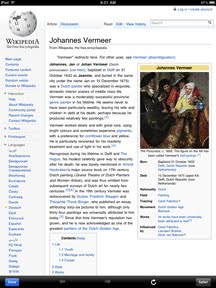
 I tapped on "Dutch" and a menu of Dutch Baroque artists popped up, then I tapped on Vermeer.

Once in the Vermeer room, a framed painting, The Milkmaid, is displayed (figure 3), along with its title, date, size and medium. On plaques above and below the painting there are links to Wikipedia information about the artist (figure 4), the Rijksmuseum in Amsterdam where the physical painting is housed, and about the painting itself. There is a scrollable filmstrip on the right that lets you browse and choose Vermeer's paintings or you can flick sideways through them, one to a page. You can also change the display to view them as thumbnails or a slideshow and even add music if you like. You can view the paintings full screen or zoom in for details (figure 5).

Figure 3
Leaving the Baroque behind and going back to the main screen, I tapped on the directory which lets you search the entire database in a variety of ways. I decided to search by subject and tapped on “birds.” The search results can be viewed in a variety of ways including thumbnails (figure 6). I randomly tapped on a brightly colored painting done in 1995 by Norval Morriseau, Bird with Young (figure 7).

Next I did a search by location and typed in Pasadena, CA where I live and work. The Norton Simon Museum came up and I went in to browse. I had forgotten about the shockingly green portrait of Van Gogh's mother from their collection (figure 8) until it nearly jumped off the screen at me.
Figure 4

Other features include slideshows, shuffle, timelines, a “Ken Burns” motion effect and the ability to save work to Favorites or the Photos app. Most of the work displayed is in the public domain and downloaded to Art Authority's servers. For more recent works still under copyright, Art Authority downloads from an authorized Web site instead.

Figure 5
On the down side, not every artist you want to know about is included. For instance -- I visited the campus of Pomona College over the weekend to see Mexican muralist Jose Clemente Orozco's mural Prometheus. Art Authority has a Muralism room in its Modern section which includes work by Mexican muralists Rivera and Siqueiros, but nothing on Orozco (or Tamayo). The Contemporary section seems very hit-or-miss to me as well.
Figure 6


That having been said, Art Authority’s value far outweighs any limitations it may have. I refer to it over and over again and often get lost browsing, discovering and learning. I highly recommend Art Authority as an invaluable reference tool -- for students of art history, artists and art aficionados alike -- that will provide endless hours of art education and enjoyment.

Click here to buy Art Authority.


Figure 7


Upcoming at Offramp Gallery


Nicholette Kominos: crumpled, cut, and divided
April 3 - May 1, 2011
Opening Reception: Sunday, April 3, 2-5pm

Tuesday, March 22, 2011

Self-Portraits: When Artists Turn Their Gaze Inward

One of the things that distinguishes us as humans is the need to leave our mark behind, to say "I was here, I mattered." We see evidence of this as far back as 10,000 years ago when our ancestors first stamped and stenciled their handprints on cave walls. More formal self-portraits start appearing as early as 2300 BC in ancient Egypt, carved on the tombs of the Pharaohs. But self-portraiture didn't become fully established as an art genre until the Early Renaissance with the advent of the manufacture of affordable flat mirrors. Luckily for us, artists have been gazing at themselves in mirrors ever since.

Phaidon Press's 500 Self-Portraits is a visual orgy, a must-have art book for anyone who is interested in the history of portraiture. This is a book you will pick up over and over again for the sheer joy of browsing. From classical to modern, naïve to sophisticated, mannered to irreverent, haunting to humorous -- it's all here in this one affordable volume.


Caravaggio, Self-portrait as Bacchus. Oil on canvas,
670 x 530mm (26 3/8 x 21"). Galleria Borghese, Rome
The reproductions in 500 Self-Portraits are presented in chronological order from Ancient Egypt to the present day. A new version of a classic first published in 1937, the only text is a brief introduction by painter and writer Julian Bell (grandson of Vanessa Bell), in which he states:

"Self-portraiture is a singular, in-turned art. Something eerie lurks in its fingering of the edge between seer and seen. Looking over the faces collected in this book, we
may be disconcerted by the cumulative intensity of so many wary, wondering, self-surprised eyes. Yet what unites the individuals gathered to stare is that they are all artists. People, that is, prepared to set down their self-examination in markings that may be examined by others."

Included are five self portraits by Durer, one of which he did when he was only 13-years-old, as well as a beautiful ink drawing of him completely in the nude, leaving little to the imagination. There are ten by Rembrandt, a prolific self-portraitist, showing him chronologically throughout his life, and two by a very pretty young Elizabeth-Louise Vigee-Lebrun from the late eighteenth century. Self-Portrait, Turning by Nadar, is an early albumen print foreshadowing the later work of Eadweard Muybridge. It shows the artist in twelve separate panels as he turns toward and then away from the camera. There are two self-portraits by Chardin in his quirky head-gear and spectacles; and one done in 1906 by German painter Paula Modersohn-Becker, Self-Portrait on my Sixth Wedding Anniversary, where she depicts herself partially naked and pregnant.

If you prefer your art history with more explanatory text, then another affordable volume from the Taschen Basic Genre Series, Self-Portraits by Ernst Rebel, may be perfect for you. It looks at 35 self-portraits in depth, ranging from the mid-12th century to the present. Each of the 35 paintings is accompanied by a brief bio of the artist and an insightful interpretation of the work depicted. In his essay, "Artists in the Focus of Their Own Eyes" Rebel provides an historical framework for the paintings and reflects on the changing role of the artist in society. He states:

"Self-portraits are testimonials in which the artist's ego as his own model and motif at the same time relates to other people. Artists depict themselves as they want to be seen by others, but also as they want to distinguish themselves from them."

Self-portraits included are Moses and the Burning Bush, an early glass painting by Master Gerlauchus who depicts himself painting an inscription asking for God's mercy; James Ensor's Self-Portrait Among Masks; Velasquez’s famous La Meninas; as well as ones by Max Beckmann, Diego Rivera, Lucien Freud and many others.


Upcoming at Offramp Gallery


Nicholette Kominos: crumpled, cut, and divided
April 3 - May 1, 2011
Opening Reception: Sunday, April 3, 2-5pm

Tuesday, March 15, 2011

Painters Painting: From Abstract Expressionism to Pop


Imagine going back in time to an era in art history, talking to the artists themselves at work in their studios and hearing first-hand what their concerns, processes and influences are. Thanks to a recently re-released documentary by Emile de Antonio, we are able to come close. The time and place is post-war New York, the art is Abstract Expressionism to Pop and everything in between.

Thomas B. Hess of Art News sets the stage: “Paris was the center of Modern Art. Then the war intervened and Paris was sealed off which turned the New York scene into kind of a pressure cooker out of which a number of American artists found their own way.” In 1972, when Painters Painting was first released, Jackson Pollock, Hans Hoffman, Willem de Kooning and others had broken from the constraints of European easel painting and established Abstract Expressionism as the first truly American art form.


Striking black and white photography intercut with color gives us intimate access to the light-filled loft of de Kooning. Nearly 70 at the time, he retains a youthful air with his iconic white tousled hair and black framed glasses. He explains why he left Europe: “I felt a certain depression over there. I felt caught. I was attracted to America by movies. America seemed to be a very light place, everything seemed to be very light and bright and happy. I always wanted to come to America even as a boy -- Harold Lloyd, Charlie Chaplin, Tom Mix.”

We meet a playful Robert Rauschenberg perched high atop a ladder in front of the cathedral windows in his studio talking about the influence of the Abstract Expressionists: “What [we] had in common was touch. I was never interested in their pessimism or editorializing. You have to have time to feel sorry for yourself if you're going to be a good abstract expressionist, and, I think I always considered that a waste.”


The specter of European painting looms large in the psyches of the New York artists. Frank Stella, sitting cross-legged on the floor of his studio, talks about how the Abstract Expressionists solved the problem for him: "I didn't have to go all the way back and worry again about where I stood in relation to Matisse and Picasso, I could worry about where I stood in relation to Hoffman and Pollock."

In a revealing interview, a very pretty Andy Warhol talks in riddles and defers most of his answers to the somewhat overbearing Brigit (presumably Brigit Berlin), who is snapping Polaroids of Warhol's face at a very close range. When asked if there are any critics he likes, Warhol responds: "I like the kind of critics that when they write they just put people's names in and you go through the article and you count to see how many names they dropped in the article." Heavy.


1989 interview with filmmaker Emile de Antonio, The Making of Painters Painting

Critic Clement Greenberg weighs in on what he thinks about Pop Art: " . . . people like Lichtenstein and Warhol, they paint nice pictures. All the same? It's easy stuff, it is, it's minor, and the best of the pop artists don't seem to be more than minor. And it's scene art, the kind of art that goes over on the scene. The best art of our time or any time since Corot, not just since Monet, makes you a little bit more uncomfortable at first, challenges you more. It doesn't come that far to meet your taste, or the established taste of the market." Wise, cautionary words largely ignored even today.

A dapper Leo Castelli, seated at a large desk in his gallery, defends the role of the art dealer: "Frankly, I think this accusation that's leveled against the dealers, that they are responsible for shaping the art market is a very silly one. Naturally we are there to do the job and are doing it. Now if people, ourselves and the critics and the museums go along with us, then there is a consensus there and therefore we are right and not wrong, so . . . what we are doing is merely doing our job."

Other artists interviewed are Helen Frankenthaler (the sole woman), Jasper Johns, Barnett Newman, Hans Hofmann, Jules Olitski, Philip Pavia, Larry Poons, Robert Motherwell and Kenneth Noland. Interwoven with the interviews is footage of the artists' work from the Metropolitan Museum of Art's exhibition New York Painting and Sculpture 1940-1970.


A riveting lesson in art history from the mouths of the players themselves, Painters Painting not only gives us unique access to a particular time and place in art, it also provides a framework for the state of the current contemporary art world -- both the good and the bad -- and invaluable insight into how we got here.

Ongoing at Offramp Gallery

Theodore Svenningsen: Truth and Self Deception
February 20 - March 20, 2011
Closing Reception & Artist's Talk: Sunday, March 20, 2-5pm


Click here to read review in ArtScene.

Video walk-thru of exhibition:


Upcoming at Offramp Gallery


Nicholette Kominos: crumpled, cut, and divided
April 3 - May 1, 2011
Opening Reception: Sunday, April 3, 2-5pm


Nicholette Kominos, Like a Portal or a Tunnel #1, 24 x 19", vellum, pencil, acrylic, varnish