Tuesday, March 22, 2011

Self-Portraits: When Artists Turn Their Gaze Inward

One of the things that distinguishes us as humans is the need to leave our mark behind, to say "I was here, I mattered." We see evidence of this as far back as 10,000 years ago when our ancestors first stamped and stenciled their handprints on cave walls. More formal self-portraits start appearing as early as 2300 BC in ancient Egypt, carved on the tombs of the Pharaohs. But self-portraiture didn't become fully established as an art genre until the Early Renaissance with the advent of the manufacture of affordable flat mirrors. Luckily for us, artists have been gazing at themselves in mirrors ever since.

Phaidon Press's 500 Self-Portraits is a visual orgy, a must-have art book for anyone who is interested in the history of portraiture. This is a book you will pick up over and over again for the sheer joy of browsing. From classical to modern, naïve to sophisticated, mannered to irreverent, haunting to humorous -- it's all here in this one affordable volume.


Caravaggio, Self-portrait as Bacchus. Oil on canvas,
670 x 530mm (26 3/8 x 21"). Galleria Borghese, Rome
The reproductions in 500 Self-Portraits are presented in chronological order from Ancient Egypt to the present day. A new version of a classic first published in 1937, the only text is a brief introduction by painter and writer Julian Bell (grandson of Vanessa Bell), in which he states:

"Self-portraiture is a singular, in-turned art. Something eerie lurks in its fingering of the edge between seer and seen. Looking over the faces collected in this book, we
may be disconcerted by the cumulative intensity of so many wary, wondering, self-surprised eyes. Yet what unites the individuals gathered to stare is that they are all artists. People, that is, prepared to set down their self-examination in markings that may be examined by others."

Included are five self portraits by Durer, one of which he did when he was only 13-years-old, as well as a beautiful ink drawing of him completely in the nude, leaving little to the imagination. There are ten by Rembrandt, a prolific self-portraitist, showing him chronologically throughout his life, and two by a very pretty young Elizabeth-Louise Vigee-Lebrun from the late eighteenth century. Self-Portrait, Turning by Nadar, is an early albumen print foreshadowing the later work of Eadweard Muybridge. It shows the artist in twelve separate panels as he turns toward and then away from the camera. There are two self-portraits by Chardin in his quirky head-gear and spectacles; and one done in 1906 by German painter Paula Modersohn-Becker, Self-Portrait on my Sixth Wedding Anniversary, where she depicts herself partially naked and pregnant.

If you prefer your art history with more explanatory text, then another affordable volume from the Taschen Basic Genre Series, Self-Portraits by Ernst Rebel, may be perfect for you. It looks at 35 self-portraits in depth, ranging from the mid-12th century to the present. Each of the 35 paintings is accompanied by a brief bio of the artist and an insightful interpretation of the work depicted. In his essay, "Artists in the Focus of Their Own Eyes" Rebel provides an historical framework for the paintings and reflects on the changing role of the artist in society. He states:

"Self-portraits are testimonials in which the artist's ego as his own model and motif at the same time relates to other people. Artists depict themselves as they want to be seen by others, but also as they want to distinguish themselves from them."

Self-portraits included are Moses and the Burning Bush, an early glass painting by Master Gerlauchus who depicts himself painting an inscription asking for God's mercy; James Ensor's Self-Portrait Among Masks; Velasquez’s famous La Meninas; as well as ones by Max Beckmann, Diego Rivera, Lucien Freud and many others.


Upcoming at Offramp Gallery


Nicholette Kominos: crumpled, cut, and divided
April 3 - May 1, 2011
Opening Reception: Sunday, April 3, 2-5pm

Tuesday, March 15, 2011

Painters Painting: From Abstract Expressionism to Pop


Imagine going back in time to an era in art history, talking to the artists themselves at work in their studios and hearing first-hand what their concerns, processes and influences are. Thanks to a recently re-released documentary by Emile de Antonio, we are able to come close. The time and place is post-war New York, the art is Abstract Expressionism to Pop and everything in between.

Thomas B. Hess of Art News sets the stage: “Paris was the center of Modern Art. Then the war intervened and Paris was sealed off which turned the New York scene into kind of a pressure cooker out of which a number of American artists found their own way.” In 1972, when Painters Painting was first released, Jackson Pollock, Hans Hoffman, Willem de Kooning and others had broken from the constraints of European easel painting and established Abstract Expressionism as the first truly American art form.


Striking black and white photography intercut with color gives us intimate access to the light-filled loft of de Kooning. Nearly 70 at the time, he retains a youthful air with his iconic white tousled hair and black framed glasses. He explains why he left Europe: “I felt a certain depression over there. I felt caught. I was attracted to America by movies. America seemed to be a very light place, everything seemed to be very light and bright and happy. I always wanted to come to America even as a boy -- Harold Lloyd, Charlie Chaplin, Tom Mix.”

We meet a playful Robert Rauschenberg perched high atop a ladder in front of the cathedral windows in his studio talking about the influence of the Abstract Expressionists: “What [we] had in common was touch. I was never interested in their pessimism or editorializing. You have to have time to feel sorry for yourself if you're going to be a good abstract expressionist, and, I think I always considered that a waste.”


The specter of European painting looms large in the psyches of the New York artists. Frank Stella, sitting cross-legged on the floor of his studio, talks about how the Abstract Expressionists solved the problem for him: "I didn't have to go all the way back and worry again about where I stood in relation to Matisse and Picasso, I could worry about where I stood in relation to Hoffman and Pollock."

In a revealing interview, a very pretty Andy Warhol talks in riddles and defers most of his answers to the somewhat overbearing Brigit (presumably Brigit Berlin), who is snapping Polaroids of Warhol's face at a very close range. When asked if there are any critics he likes, Warhol responds: "I like the kind of critics that when they write they just put people's names in and you go through the article and you count to see how many names they dropped in the article." Heavy.


1989 interview with filmmaker Emile de Antonio, The Making of Painters Painting

Critic Clement Greenberg weighs in on what he thinks about Pop Art: " . . . people like Lichtenstein and Warhol, they paint nice pictures. All the same? It's easy stuff, it is, it's minor, and the best of the pop artists don't seem to be more than minor. And it's scene art, the kind of art that goes over on the scene. The best art of our time or any time since Corot, not just since Monet, makes you a little bit more uncomfortable at first, challenges you more. It doesn't come that far to meet your taste, or the established taste of the market." Wise, cautionary words largely ignored even today.

A dapper Leo Castelli, seated at a large desk in his gallery, defends the role of the art dealer: "Frankly, I think this accusation that's leveled against the dealers, that they are responsible for shaping the art market is a very silly one. Naturally we are there to do the job and are doing it. Now if people, ourselves and the critics and the museums go along with us, then there is a consensus there and therefore we are right and not wrong, so . . . what we are doing is merely doing our job."

Other artists interviewed are Helen Frankenthaler (the sole woman), Jasper Johns, Barnett Newman, Hans Hofmann, Jules Olitski, Philip Pavia, Larry Poons, Robert Motherwell and Kenneth Noland. Interwoven with the interviews is footage of the artists' work from the Metropolitan Museum of Art's exhibition New York Painting and Sculpture 1940-1970.


A riveting lesson in art history from the mouths of the players themselves, Painters Painting not only gives us unique access to a particular time and place in art, it also provides a framework for the state of the current contemporary art world -- both the good and the bad -- and invaluable insight into how we got here.

Ongoing at Offramp Gallery

Theodore Svenningsen: Truth and Self Deception
February 20 - March 20, 2011
Closing Reception & Artist's Talk: Sunday, March 20, 2-5pm


Click here to read review in ArtScene.

Video walk-thru of exhibition:


Upcoming at Offramp Gallery


Nicholette Kominos: crumpled, cut, and divided
April 3 - May 1, 2011
Opening Reception: Sunday, April 3, 2-5pm


Nicholette Kominos, Like a Portal or a Tunnel #1, 24 x 19", vellum, pencil, acrylic, varnish 

Tuesday, March 8, 2011

Uncommon Genius

I recently got an email from a reader, Sylvia Marcin, who suggested a book she thought I might enjoy reading. A couple of hours later, friends of mine came through the front door raving about the same book. I assumed it was something new that everyone was reading. But it turns out that Uncommon Genius: How Great Ideas Are Born by Denise Shekerjian, was first published in 1990 -- ancient in terms of today's lightening fast information exchange. The universe was telling me to read this book.

Author Shekerjian interviewed 40 "geniuses" for this book, all of whom had one thing in common -- they each received a phone call one day, out of the blue, informing them that they would receive a large amount of money, no strings attached, over the next five years, to do whatever they wanted with. They were recipients of the coveted MacArthur Award, a.k.a. the "genius award."

At the time of his death in 1978, John D. MacArthur was the second richest man in America and rumored to be the cheapest. But he left behind a two and a half billion dollar estate in the form of a foundation with only the following instructions to his board of trustees: "I figured out how to make the money, you boys figure out how to spend it." Thus the MacArthur Award was born. Its purpose "is to promote those leaps of creative thinking that may occur when gifted people are left to their own devices."


Shekerjian began writing Uncommon Genius wanting to know everything about the creative impulse: Where does it come from? How does it work? Can it be encouraged? Why are some people more creative than others? These are some of the questions she asks of artist Robert Irwin, educator Deborah Meier, filmmaker Fred Wiseman, theater/opera director Peter Sellars, journalist Richard Critchfield, archaeologist Ian Graham, sociologist Sara Lawrence Lightfoot, and clown/actor Bill Irwin, to name a few.

Sherkerjian isolates a list of eight simple principles of creativity that emerge from her interviews:

1. Find your talent.
2. Commit to it and make it shine.
3. Don't be afraid of risk. Or even failure, which if seen in its proper light, brings insight and opportunity.
4. Find courage by looking to something stronger and better than your puny vulnerable self.
5. No lusting after quick resolutions. Relax. Stay loose.
6. Get to know yourself; understand your needs and the specific conditions you favor.
7. Respect, too, your culture. We can't, any of us, escape the twentieth century. It's tucked up around our collective chin as snugly and as firmly as the bedsheet.
8. Then, finally, break free from the seductive pull of book learning and research and the million other preparatory steps that could delay for the entire span of a life and immerse yourself in the doing.

Sherkerjian goes on to look in depth at topics such as travel, luck, instinct, judgment, despair, isolation, madness and resiliency; and the role they play in the creative lives of the diverse group of Fellows. She emphasizes the importance of resiliency in creative effort: "The MacArthur Fellows are not quitters. Even in the face of insult. Or when confronted with defeat. Or when up against humiliation, despondency, hostility, boredom, or indifference. They find a way to make adjustments, to keep at it, to stay buoyant, to believe in themselves."

In her final chapter "For the Love of It" Sherkerjian tells the story of the truly inspiring Ellen Stewart, founder of the La Mama Theater. Ellen dreamed of becoming a fashion designer. As a child, she entered and won a design contest, which "earned her a smack in the mouth when she went to collect her prize for having had the audacity to enter it . . ." Ellen had committed the crime of being black.

Undeterred, she pursued her dream and eventually took off for New York. When the friend she was going to live with was a no-show at Grand Central Station, Stewart found herself alone in the big city. She wandered into St. Patrick's Cathedral, lit a candle and prayed for a job. About a half hour later she had that job -- across the street at Saks, pushing a broom. Her broom-pushing gave way to design opportunities and her gowns eventually ended up in the window of Saks fetching as much as $1500 each.

That alone is an inspiring story, but Stewart was depressed. She quit Saks after 11 years and headed off to Morocco. There she had a dream that set her in a new direction -- forming a theater for aspiring actors, playwrights, stagehands and set designers, dedicated to helping artists get a start. La Mama went on to become one of the most influential experimental theaters in the world. Stewart died earlier this year at the age of 91.


So whether you are someone who is thinking of making a life-changing leap into a different field, or someone who just needs a creativity tune-up, Uncommon Genius is an intimate and inspiring glimpse into the creative process of 40 uncommonly creative people.


Click here to buy the book from Amazon.com.

Click here to purchase products from the Offramp Gallery Blog Store.


Ongoing at Offramp Gallery

Theodore Svenningsen: Truth and Self Deception
February 20 - March 20, 2011
Closing Reception & Artist's Talk: Sunday, March 20, 2-5pm


Click here to read review in ArtScene.

Video walk-thru of exhibition:


Upcoming at Offramp Gallery

April 3 - May 1, 2011
Opening Reception: Sunday, April 3, 2-5pm

   
Nicholette Kominos, Like a Portal or a Tunnel #1, 24 x 19", vellum, pencil, acrylic, varnish 

Tuesday, March 1, 2011

Synesthesia: A Crossing of the Senses

At a dinner party recently my friend James mentioned that he had synesthesia -- something I had never heard of. He explained that since childhood he had seen numbers and letters as specific colors. For James, 1 is always white, 2 is always yellow, A is apricot, B is blue, and so forth. Synesthesia, he explained, is when two or more sensory areas of the brain cross-connect. You either have synesthesia or you don't -- it is not a learned ability.

James is an artist so I wanted to know if this phenomenon in any way manifested itself in his paintings. He said it didn't, but it did help him remember telephone numbers -- he could see and read the sequence of numbers as colors -- a very different experience than say, rote memorization or deliberately assigning specific colors to numbers to use as a mnemonic device. He says it also useful to him by setting "a nonverbal emotional tone to the simplest of thoughts."

I was intrigued and more than a little jealous of James's exotic ability, which I clearly did not possess.

The next day, I started researching and soon learned that synesthesia can manifest as a crossing of any two or more senses. Some synesthetes taste sounds, some see music, some can see and feel tastes, and some have combinations of three or four senses simultaneously.


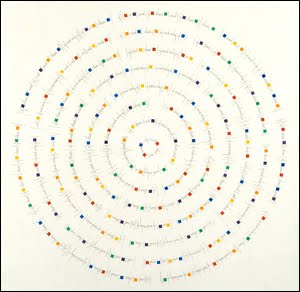
In my research I came across a diagram of a "spatial sequential" synesthesia depicting the months of the year as an oval-like shape, and realized that I actually did have this particular type of synesthesia. I have always known which month of the year we are in by its location on my own idiosyncratic shape and its relationship to my body. I've seen the calendar this way since I was a child and never thought it was anything special or even worth mentioning.

Below is a rough two dimensional sketch of my calendar that I did on my iPad. The colors in the sketch don't mean anything (I just like them).


Neurologist and researcher Richard Cytowic, also stumbled on the phenomenon at a dinner party many years ago. His host that evening apologized that there weren't "enough points on the chicken." When Cytowic asked him what he meant, his host explained that when he tasted something intense, the feeling would sweep down his arm into hand where he felt a shape, weight, texture and temperature. He had wanted the chicken to be a prickly, pointed sensation, but it came out "all round."

This chance encounter lead to the research that resulted in Cytowic's two books on the subject: The Man Who Tasted Shapes, and Wednesday Is Indigo Blue: Discovering the Brain of Synesthesia (co-authored with David M. Eagleman), both concerning the research and experimentation that has led to synesthesia being taken seriously. It was ignored for many years because of a lack of scientific data. Brain scans have definitively proven that more than one sensory area of the brain simultaneously lights up when synesthesia is experienced. These findings, and others, have changed the way scientists think about the brain and how we perceive the world.

Research also shows that synesthesia tends to run in families and is an inherited trait. However, the connections that are formed -- for instance in my friend James's case, where 2 is always yellow -- happen in early childhood and become fixed for life. Even identical twin synesthetes will have different associations for the same number or letter.

The following video is of a lecture Cytowic gave at the Hirshhorn Museum in conjunction with its exhibition "Visual Music," featuring music-inspired art. Some of the artists in the exhibit, most notedly Kandinsky, were synesthetes and painted what they saw, while others, such as Georgia O'Keefe, did not have this ability and instead consciously translated the music.


If you would like to know if you have synesthesia, there is a research website, The Synesthesia Battery, that allows you to test yourself. If you are synesthetic, I would love to hear about your experiences in the comments section below.

Ongoing at Offramp Gallery

Theodore Svenningsen: Truth and Self Deception
February 20 - March 20, 2011
Closing Reception & Artist's Talk: Sunday, March 20, 2-5pm

Offramp Gallery is pleased to present a solo exhibition, Theodore Svenningsen: Truth and Self Deception from February 20 - March 20, 2011. There will be a closing reception and artist's talk on Sunday, March 20, from 2-5pm.


Click here to read review in ArtScene.

In Svenningsen's text pieces the work exists at a place where narrative meanings of words can give way to being seen solely as aesthetic objects. The work explores this conflation of the narrative and the aesthetic. Some of the pieces are self-referential. These pieces investigate, critically, the underpinnings of theory-driven art. Some explore the interrelationships between individual persons and the larger group, and look at the difficulties and inabilities of these certain individuals to fit in. Logic symbolism forms the bases of the aesthetic element in a number of the pieces.

Click here for more information

Click here to purchase products from the Offramp Gallery Blog Store.


Tuesday, February 22, 2011

Discovering Sam Maloof


Maloof was born in 1916 in Chino, CA, the son of Lebanese immigrants. Encouraged by his wife, Alfreda, Maloof began his woodworking career around 1948, giving up a job in graphic design for his first furniture commission. Completely self-taught, he had no formal training in woodworking whatsoever. Within ten years, his name was known to woodworkers and collectors around the world.

In the 1960’s Maloof turned down an offer of $22 million for the rights to mass-produce his original designs. He believed passionately in the handmade object: "We marvel and exclaim about the machine, and yet nothing has been designed or made, nor ever will be, as wondrous as the hands of man. What it produces has no element of surprise or feeling that an object made by hand may have. It leaves no room for change."

In 1985, Maloof became the first craftsman to receive a MacArthur Genius Fellowship. His furniture is in the collections of the Smithsonian, the Metropolitan Museum of Art, the Boston Museum of Fine Arts and the White House Craft Collection.

One of the first things you learn when you enter the Maloof property is that the house you are about to tour wasn't always in its current location. The original site had been in the path of the Foothill Freeway expansion project, but fortunately could not be torn down because it was on National Register of Historic Places. A new house was built for Sam and the old house and woodshop were moved to the new site in 2001 to be preserved as a living museum. Sam lived and worked there until his death at age 93 in 2009.


Since we had arrived a few minutes early for our tour, the docent took us for a quick look at two climate-controlled storehouses where raw planks and boards are stored, and the woodshop, where Sam's hand-picked assistants still make his furniture. The shop, filled with saws, lathes, tools, patterns, partially made furniture, wood and saw dust, offered us a tantalizing glimpse into the magic that turns raw wood into functional art.

Meandering through the compound on wooden pathways surrounded by lush vegetation, we started our formal tour at the original house, which was built by Maloof. It is immediately apparent that this was an artist's house -- lived in, worked in, added on to as time and money allowed. The downstairs floors are made of unmortared brick, because Sam liked the sound they made when he walked on them. No two doors are alike -- the handmade sculptural locks and latches for each are a marvel in and of themselves.

The 26 rooms meander maze-like and vary in size, shape and function. A spectacular wooden spiral staircase that Maloof built climbs from the main floor to a sleeping loft above. Suspended in a two-story atrium is a handcrafted wooden canoe that Maloof commissioned from a craftsman to fit between the balconies. The house contains the largest collection of Maloof furniture anywhere, as well as the Maloof's collection of pottery, rugs, blankets, art, toys, kachina dolls, masks and contemporary art.

Sam's wife of 50 years, Alfreda, who managed the business side of Maloof woodworking, died in 1998. Sam remarried in 2001, to a collector, Beverly Wingate. Beverly still lives on the site and has developed a beautiful six acre garden with California natives and Mediterranean climate compatible plantings. Dedicated in 2004, the garden is Certified Wildlife Habitat. A self-guided tour of the gardens is open to the public and free of charge.


As part of the the Getty Foundation's Pacific Standard Time collaboration, the Huntington Library will present The House that Sam Built: Sam Maloof and Art in the Pomona Valley 1945-1985, from September 24, 2011 - January 30, 2012. The exhibition will showcase about 30 important Maloof pieces spanning more than three decades of his career in a display integrated with approximately 80 works by about 30 of his friends and colleagues who worked in other media.

Click here for more information about the Foundation and tours.

Click here to purchase products from the Offramp Gallery Blog Store

Upcoming events at Offramp Gallery

Theodore Svenningsen: Truth and Self Deception
When the name Sam Maloof came up twice in one day recently, I realized I didn't know much about him -- I had a vague image of a rocking chair in my mind. A quick Google search later I discovered that not only was Maloof considered one of the greatest woodworkers of all time, but that his house, woodshop and gardens are open for public tours in Rancho Cucamonga, just 35 miles east of where I live and work.
February 20 - March 20, 2011
Closing Reception: Sunday, March 20, 2-5pm


Offramp Gallery is pleased to present a solo exhibition, Theodore Svenningsen: Truth and Self Deception from February 20 - March 20, 2011. There will be an opening reception on Sunday, February 20, from 2-5pm.

In Svenningsen's text pieces the work exists at a place where narrative meanings of words can give way to being seen solely as aesthetic objects. The work explores this conflation of the narrative and the aesthetic. Some of the pieces are self-referential. These pieces investigate, critically, the underpinnings of theory-driven art. Some explore the interrelationships between individual persons and the larger group, and look at the difficulties and inabilities of these certain individuals to fit in. Logic symbolism forms the bases of the aesthetic element in a number of the pieces.

Click here for more information

Tuesday, February 8, 2011

L.A. Rising

I've been fortunate enough to have lived and worked in the arts for many years in both Los Angeles and New York City. I love both cities and know the advantages and disadvantages of each. I also know that New Yorkers tend to have a superiority complex about Los Angeles and its cultural life -- or lack of one as they see it.

Nothing could be further from the truth, but like everything else in Los Angeles, the cultural scene is spread out over a large geographical area and tends not to have a well-defined center. In her recently released L.A. Rising, SoCal Artists Before 1980, author Lyn Kienholz takes a big step forward in marking out a non-geographic center. L.A. Rising is an encyclopedia of 500 Southern California artists living and working in L.A. before 1980. Each artist is given a page with reproductions of their work from that era and information and reviews about their work excerpted from publications of the same period.


Author Kienholz, who was married for a time to artist Edward Kienholz and worked the front desk at the legendary Ferus Gallery, has made it her mission to spread the word about art in Los Angeles. In 1980, she founded the California/International Arts Foundation to increase the visibility of LA art and artists worldwide. The Foundation has organized exhibitions in 56 museums and 23 countries, including the 2006 exhibition Los Angeles: 1955-1985 at the Centre Pompidou in Paris.

Besides finding L.A. Rising an invaluable reference tool that every visual arts professional should have, it is also a lush and highly entertaining stroll down memory lane for anyone who has watched the L.A. art scene. There are the big names that you would expect: David Hockney, John Baldessari, and Judy Chicago. There are artists you've never heard of, but would like to know more about. There are artists you've forgotten and are happy to rediscover. There are friends, teachers, colleagues and more -- some living, some sadly departed. Most of all, there is the richness of the art, which includes every medium from ceramics to performance, printmaking to installation, photography to sculpture.

The one thing I found missing from L.A. Rising is biographical information about the artists. The text, which is culled from newspaper and magazine articles referencing each artist, while interesting, doesn't go far enough. I realize what a tall order that is, and hope that in some future edition it will be rectified.

Meanwhile, thank you Lyn Kienholz for this beautiful, informative, must-have art book.


News & Events at Offramp Gallery

Thanks to everyone who came out on Sunday for Anita Bunn artist's talk. Congratulations to Anita, whose show, The Sun Tells Quite Another Story, was an all-around success!
 

Anita Bunn, artist's talk at Offramp Gallery 2/6/11

Anita Bunn, artist's talk at Offramp Gallery 2/6/11


Upcoming
February 20 - March 20, 2011
Opening Reception: Sunday, February 20, 2-5pm


Offramp Gallery is pleased to present a solo exhibition, Theodore Svenningsen: Truth and Self Deception from February 20 - March 20, 2011. There will be an opening reception on Sunday, February 20, from 2-5pm.

In Svenningsen's text pieces the work exists at a place where narrative meanings of words can give way to being seen solely as aesthetic objects. The work explores this conflation of the narrative and the aesthetic. Some of the pieces are self-referential. These pieces investigate, critically, the underpinnings of theory-driven art. Some explore the interrelationships between individual persons and the larger group, and look at the difficulties and inabilities of these certain individuals to fit in. Logic symbolism forms the bases of the aesthetic element in a number of the pieces.

Click here for more information

Tuesday, February 1, 2011

The Gardner Heist, Stendhal's Syndrome & Double Rainbow Mash-Up

 
(updated 8/15/11) The Gardner Heist, Ulrich Boser's 2009 bestseller about the largest art heist in history, is a fascinating true-crime whodunit, a wild ride through the underbelly of the art world -- a dangerous place described by experts as the "Lost Museum" where enough stolen artworks exist to make the "Louvre seem like a small-town art gallery in comparison."

Early on the morning of March 18, 1990, two men dressed as police officers broke into the Isabella Stewart Gardner Museum in Boston, tied up the two guards on duty and stole 13 works of art, including three Rembrandts and a Vermeer. Estimates place the value of the stolen works at around $500 million and the case remains unsolved to this day.

The paintings were not insured and in any case couldn't be replaced with other work because of Gardner's will, which forbade any changes to her museum. "Nothing could be added or taken away. Not a Chippendale chair, not a Rembrandt canvas, not a bamboo window shade. Everything must remain in the same Victorian patchwork of wood-paneled corners and draped alcoves, or the trustees would be required to sell off the collection and donate the profits to Harvard University."

Author Ulrich Boser stumbles into the Gardner case after contacting veteran art detective Harold Smith in 2005 to write an article about him. Boser soon learns that there is one case that haunts Smith, the Gardner heist: "Smith had been searching for the missing masterpieces for years. He hopscotched the globe to meet with sources. He spent hundreds of thousands of his own money on leads . . . [he] swore to everyone that he met that he wouldn't stop working the case until the art hung again on the walls of the museum."

The elderly Smith dies suddenly (of natural causes) a few weeks after his initial meeting with Boser, but not before Boser has become interested in the case. With the family's blessing and access to Smith's files, he picks up the trail of the investigation and ultimately becomes obsessed with the crime:

"It was more like a mystery with a capital M, the sort of enigma that you find in church pews or philosophy lectures or on the canvas of an Old Master painting, something clear and compelling but also abstruse and obscure, something essentially unknowable."

Your hopes will soar and come crashing down as Boser tracks down every lead, only to find countless dead-ends, nefarious characters, encounters with the Irish mob, death threats, bodies in trunks of cars, and endless speculation.

You'll learn that "most art crooks are motivated by the lure of easy money and, relative to their size, top-notch paintings represent some of the most valuable items on the planet. A minor Picasso or Van Gogh carries a bigger price tag than the finest diamonds or the purest gold, and a major canvas by an Old Master might have the value of a Gulfstream jet or a small ocean liner." You'll also learn that because famous stolen paintings are almost impossible to sell, they are used as a type of underworld cash or bond, traded for guns, drugs or jewels.

You will cringe as you read how the thieves mishandled the priceless paintings, breaking them from their frames and slashing them off the stretcher bars, leaving behind "bits of canvas, flecks of paint, and the dreams of countless art lovers."

Speculation about what condition the paintings might be in today will make you want to cry: "An Old Master painting is as dry and brittle as a potato chip, and if it's removed from its setting, the canvas can bend and buckle and crack, the paint peeling off in thick flakes like dried glue."

After tracking down hundreds of leads and conducting over 200 interviews, Boser feels he is no closer to solving the case than when he started. He believes that brutal Boston mob boss Ray "Whitey" Bulger holds the key to finding the Gardner paintings. Having been told that Bulger is hiding out in a seaside village in Ireland, Boser impulsively books a flight there. After moving from village to village, strolling the streets hoping to spot Bulger, he realizes his obsession has gotten out of control: "It had been a wild, harebrained scheme from the start. My zeal had gotten the better of me. I felt stupidly naive. There were never any concrete clues of an Irish angle."

In the end, Boser returns home and doesn't solve the case. He does, however, put forth a plausible scenario based on his research and new evidence that he uncovers by interviewing witnesses that the police ignored. He believes that the mystery may ultimately be unsolvable due to the untimely and violent deaths of key figures. We, like Boser, are left knowing the masterpieces are out there somewhere and wondering if they will ever resurface to be replaced in their empty frames awaiting them at the Gardner.

Click here to buy The Gardner Heist from Barnes & Noble

Stendhal's Syndrome

Wikipedia describes Stendhal's syndrome (or hyperkulturemia) as:

"a psychosomatic illness that causes rapid heartbeat, dizziness, fainting, confusion and even hallucinations when an individual is exposed to art, usually when the art is particularly beautiful or a large amount of art is in a single place."

The syndrome is named after the 19th century French author Stendhal (pseudonym of Henri-Marie Beyle), who described his experience with the phenomenon during his 1817 visit to Florence in his book Naples and Florence: A Journey from Milan to Reggio.

Stendhal recounted: "On leaving the Santa Croce church, I felt a pulsating in my heart. Life was draining out of me, while I walked fearing a fall."

It wasn't until more recent times that a Florentine psychiatrist, Dr. Graziella Magherina, labeled the phenomenon "Stendhal's Syndrome" having treated many patients with similar symptoms. Magherini wrote a book on the subject, La Sindrome di Stendhal, where she looks at over a hundred case studies.
While I don't know if it would qualify as Stendhal's Syndrome, I did burst out crying in front of a painting years ago, at LACMA here in Los Angeles (that just doesn't have the same ring to it as the Uffizi in Firenze).
Wassily Kandinsky, Lady in Moscow,
1912, Stadtische Galerie im Lenbachhaus,
Munich, Germany


It was an emotionally difficult time in my life and the painting was an early Kandinsky, Lady in Moscow (left). That black blob hovering over an otherwise normal, happy-looking scene did me in. Embarrassed, I made a beeline to the nearest restroom until I could get myself under control.

Anyone else dare to admit to such 19th century hysterics? Let me know.


Double Rainbow/Donald Judd Mash-Up

Speaking of art and hysterics, thanks to artist Susanna Dadd for sending me the following hysterical video:


Untitled from VJ Peter Rand on Vimeo.


Currently on View at Offramp Gallery

Please join us for a closing reception and artist's talk with Anita Bunn on Sunday, February 6, 2-5pm.In her second solo show at Offramp Gallery, The Sun Tells Quite Another Story, photographer Anita Bunn presents a new series of works that continue her exploration of the act of noticing as well as the temporal nature of the still and moving image. 


Upcoming at Offramp Gallery


Theodore Svenningsen: Truth and Self Deception
February 20 - March 20, 2011
Opening Reception: Sunday, February 20, 2-5pm